

I’ve been blessed enough to be in this game since we were tracking memberships on good old rolodexes and “recovery” was a lukewarm Isotonic or coca cola and a cigarette in the parking lot for some. I’ve built clubs from Johannesburg to Jeddah, and if there is one thing that keeps me up at night besides a faulty HVAC system it is seeing operators leave money on the table because they’re still married to a 1998 pricing strategy.
Static pricing is a soon to be dinosaur, and 2026 could be the meteor. If you’re still charging the same flat rate for the guy who uses the squat rack at 5:00 PM on a Monday and the lady who uses the treadmill at 10:00 AM on a Thursday, you aren’t a “premium operator.” You may just be a charity with better lighting.
Here is a quick breakdown of why I think dynamic and flexible models are the only way to survive the current margin squeeze.
1. The Yield Management Revolution
In the old world, we sold “access.” In 2026, we need to sell capacity, usage and outcomes. Similar to airlines or hotels, fitness centers have “perishable inventory.” A spin bike or treadmill sitting empty at 2:00 PM is revenue that will never be seen again. Space and Equipment utilization needs to be at the top of the agenda in weekly meetings.
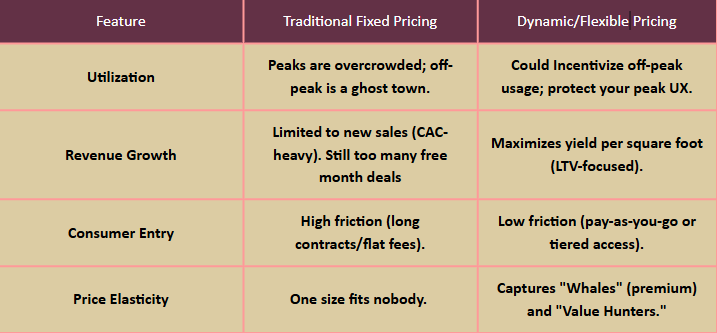
Here is a quick reference table on dynamic vs fixed: Comparative Reality:
2. Why “Flexible” is the New “Loyal”
We used to think contracts equaled loyalty. Wrong. Contracts equal resentment in a lot of cases. Modern consumers, especially the Gen Z and Alpha cohorts we are seeing dominate the Asian and urban US and Middle Easter markets , view flexibility as a premium feature.
The Benefits of the Shift:
Capacity Smoothing:
By using price as a lever, you migrate your “budget” members to off-peak hours. This clears the floor for your “premium” members who are willing to pay a 40% surcharge to ensure they don’t have to wait for a bench at 6:00 PM.
Data-Driven Monetization:
We now have the tech to see that a certain cohort only uses the recovery suite (sauna, cold plunge, compression). Why charge them for the gym floor? By unbundling and then “smart-bundling,” you increase your Average Revenue Per Member (ARPM).I once had a member that only ever used the sauna , ate breakfast chatted to all the staff and never used the actual training floor -ever.I can hear the minds turning now, “but that’s how it works” , he has to pay full board- remember you not selling only access anymore.
Predictive Churn Mitigation:
If your AI tells you a member’s usage is dropping, a dynamic system can automatically offer a “flex-down” tier rather than letting them hit the “Cancel” button. It’s easier to up-sell a warm lead later than to re-acquire a cold one.
3. Engineering the “Value Stack”
If you want to maximize your P&L, you have to stop thinking about “membership” and start thinking about “Wallets.”
1. The Base Layer: Digital-only or off-peak access. (The “Low-Cost Entry”).
2. The Core Layer: Standard access with “credits” for boutique classes.
3. The Performance Layer: Outcome-based. This includes biometrics, VO2 Max testing, and personalized coaching. You don’t charge for the “gym”; you charge for the 5% body fat reduction.
4. The Recovery Bolt-on: In 2026, “Rest is the new Rep.” High-margin recovery services should be dynamically priced based on demand (e.g., Friday evening sauna sessions cost more than Tuesday/Wednesday mornings).
The Bottom Line
If your pricing isn’t breathing, it’s dying. We are moving toward a “Fitness-as-a-Service” (FaaS) model where the price reflects the real-time value of the environment. Operators who embrace this will see a 15–25% lift in bottom-line EBITDA simply by optimizing the bodies already in the building.
The “Old Guard” will call it confusing. The “New Guard” will call it profit. Which side of that ledger do you want to be on?
When you look at your current member data, what percentage of your “Peak Hour” users are your lowest-paying legacy members?
Leave a Reply